Showing posts with label 2013. Show all posts

Friday, January 24, 2014

Choice Outstanding Academic Title for 2013

Choice named New Horizons in Geometry by Tom Apostol and Mamikon Mnatsakanian an Outstanding Academic Title for 2013.


New Horizons in Geometry represents the fruits of 15 years of work in geometry by a remarkable team of prize-winning authors—Tom Apostol and Mamikon Mnatsakanian. Apostol and Mamikon provide fresh and powerful insights into geometry that requires only a modest background in mathematics. Using new and intuitively rich methods, they give beautifully illustrated proofs of results, the majority of which are new, and frequently develop extensions of familiar theorems that are often surprising and sometimes astounding. It is mathematical exposition of the highest order. The hundreds of full color illustrations by Mamikon are visually enticing and provide great motivation to read further and savor the wonderful results. It is an understatement to say that Apostol and Mamikon have breathed new life into geometry.


Purchase your copy today in the MAA Store or the MAA eBooks Store

Friday, December 20, 2013

MAA Books Beat: Calculus Online and Geometric Excursions

Written by Steve Kennedy, MAA Books Beat is a new column that will appear in MAA Focus. The first article, Calculus Online and Geometric Excursions, appears in the December 2013/January 2014 issue. 

Calculus Online and Geometric Excursions

by Steve Kennedy

My department used the same calculus text for well over a decade. We’re a traditional place, and we used a traditional text. It is a splendid book–terrific exposition with great problems. A year or so ago, yet another edition came out, and we, collectively, gulped when we saw the price tag. More than $200. We decided to stop fiddling around and look seriously at alternatives. After a long and careful comparison period during which we read and discussed a big pile of calculus books, we chose an alternate text. This text features good exposition and good problems and, more to my present point, a price tag $100 lower than the original book.

The publisher’s representative of our original text learned of our decision and the reason for it, and offered various discount prices for various lengths of time. After considering the options, we moved on to the new text. This bargaining session left me feeling annoyed and manipulated. I’m a teacher. I’m not interested in playing negotiating games. I want to help my students learn and grow, and I would like publishers to help me by providing good books at fair prices–not marketing manipulations and games.

Now I work for a publisher. A publisher that, I believe, shares my view that our role is to provide quality books, especially textbooks, at reasonable prices. This publisher also puts out the newsmagazine you are reading. My new job (just part time; I’m still a math teacher) is to acquire those quality books from you, the MAA members who are writing them.

Your probably don’t think of the MAA as a publisher, and that’s natural. We are, primarily, a collective of professionals working together to advance and promote mathematics. But producing books of enduring value is a part of that collective effort. We’re a funny kind of publisher because the people writing the books and the people buying the books are, essentially, the same: MAA members.

One part of my new job is to market those books. I’m not really sure how best to do that, although I’m dead-set against backroom bargaining and rapid edition switching designed to kill the used-book market. I prefer to calmly point out to you the virtues of some of our books. I intend to use this space on a regular basis to highlight some of the terrific books we are publishing. I intend also to, frequently and loudly, point out the following: We publish really good books at very reasonable prices. You ought to buy them.

Let me tell you about two of them.

Friday, December 13, 2013

New MAA eBook

Illustrated Special Relativity Through Its Paradoxes
A Fusion of Linear Algebra, Graphics, and Reality
by John dePillis and José Wudka

Illustrated Special Relativity illustrates and resolves several apparent paradoxes of special relativity including the twin paradox and train-and-tunnel paradox. Assuming a minimum of technical prerequisites the authors introduce inertial frames and use them to explain a variety of phenomena: the nature of simultaneity, the proper way to add velocities, and why faster-than-light travel is impossible. Most of these explanations are contained in the resolution of apparent paradoxes, including some lesser-known ones: the pea-shooter paradox, the bug-and-rivet paradox, and the accommodating universe paradox. The explanation of time and length contraction is especially clear and illuminating.

At the outset of his seminal paper on special relativity, Einstein acknowledges the work of James Clerk Maxwell whose four equations unified the theories of electricity, optics, and magnetism. For this reason, the authors develop Maxwell’s equations which lead to a simple calculation for the frame-independent speed of electromagnetic waves in a vacuum. (Maxwell did not realize that light was a special case of electromagnetic waves.) Several chapters are devoted to experiments of Roemer, Fizeau, and de Sitter to measure the speed of light and the Michelson-Morley experiment abolishing the aether.

Throughout the exposition is thorough, but not overly technical, and often illustrated by cartoons. The volume might be suitable for a one-semester general-education introduction to special relativity. It is especially well-suited to self-study by interested laypersons or use as a supplement to a more traditional text.

Purchase your copy today in the MAA eBooks Store.

Friday, November 22, 2013

Donald L. Vestal Reviews In the Dark on the Sunny Side

Donald L. Vestal reviews In the Dark on the Sunny Side by Larry W. Baggett as part of MAA Reviews.

On a summer day in 1944, five-year-old Larry Baggett used a paring knife to cut a string for a much-needed ammo sack for his slingshot. But, after violating the “Never cut toward yourself” rule, he accidentally sent the point of the knife into his right eye. And over the next few weeks, after multiple treatments and surgeries, he gradually lost sight in both eyes. What becomes of a blind kid in 1940s America? Does he become a jazz musician? A lawyer? A physicist?

The answer turns out to be: a math professor. In this memoir, Baggett details his path towards professorhood. But the path is not so much about the math, but about the normal and sometimes abnormal things that people go through, some of which — but not all — are unique to the blind.

As a blind child in the 40s and 50s, Baggett experienced the very beginning of the mainstreaming movement. Although his early schooling took place at the Perkins School for the Blind, for fourth grade he left the community of the blind to be educated at Gotha School.

Read the full review here.

Friday, October 25, 2013

Annie Selden Reviews Distilling Ideas

Annie Selden reviews Distilling Ideas: An Introduction to Mathematical Thinking by Brian P. Katz and Michael Starbird as part of MAA Reviews. 

The authors of this book, as they explain in their first chapter, are taking readers/students on a journey — one that will “add new, powerful inquiry skills” to a student’s repertoire: abstraction, exploration, conjecture, justification, application, and extension. The book is clearly intended for inquiry-based mathematics courses. It is replete with explorations to undertake, definitions to explore, and theorems to prove, but there are no sample proofs or answers.

The book has five chapters, with the middle three chapters on graphs, groups, and ε-δ calculus constituting the bulk of the book. To me, it is clear that any one of these middle chapters by itself has the potential to be used for an entire one-semester course. There is really enough material in the ε-δ calculus chapter for an introductory junior level real analysis course. Similarly, the group theory chapter gets to Sylow’s Theorem and has more in it than most students could cover in one-semester when doing all the work themselves.

Read the full review here


Annie Selden is Adjunct Professor of Mathematics at New Mexico State University and Professor Emerita of Mathematics from Tennessee Technological University. She regularly teaches graduate courses in mathematics and mathematics education.

Friday, October 18, 2013

New in the MAA Store

Now available in print at the MAA Store.

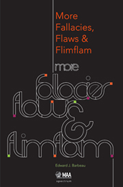
More Fallacies, Flaws & Flimflam

by Edward J. Barbeau
Spectrum Series

More Fallacies, Flaws, and Flimflam is the second volume of selections drawn mostly from The College Mathematics Journal column “Fallacies, Flaws, and Flimflam” from 2000 through 2008. More Fallacies, Flaws, and Flimflam contains items ranging from howlers (outlandish procedures that nonetheless lead to a correct answer) to deep or subtle errors often made by strong students.

Friday, October 11, 2013

More Fallacies, Flaws and Flimflam

More Fallacies, Flaws and Flimflam More Fallacies, Flaws and Flimflam by Edward J. Barbeau is now available in the MAA eBooks Store. A paperback version will be available in the MAA Store soon.

Here is another collection of Fallacies, Flaws and Flimflam, mostly drawn from the column of this name in The College Mathematics Journal between 2000 and 2008. As in the first volume, there is a variety of items ranging from howlers (outlandish procedures that nonetheless lead to a correct answer) to errors that are deep or subtle often made by strong students. While some are provided for entertainment, others offer a challenge to the reader to determine exactly where things go wrong.

There are many proposals to improve the quality of mathematics education, but they seldom address the need for students to pay careful attention to what they do and to check their work. It is through an engagement with meaning that students can avoid the pitfalls that come too naturally. Accordingly, this volume should be useful to teachers at all levels by giving them examples of flawed work they can use in the classroom. Encouraging students to find where someone else went wrong may help them avoid similar errors in the future.

The items are sorted according to subject matter. Elementary teachers will not find much of use beyond Chapter 1, while middle and secondary teachers will find items in Chapters 1, 2, 3, 7, 8 that they might use. College teachers should find material in every part of the book.

The mathematical topics covered include arithmetic, algebra, trigonometry, geometry, combinatorics, probability, and calculus.

Friday, October 4, 2013

Teaching with MAA's Online Calculus Textbook

Dr. Gwyn Whieldon, Assistant Professor of Mathematics at Hood College, talks about using MAA's online interactive textbook Calculus: Modeling and Application in her classes. 


Interested in using Calculus: Modeling and Application? Learn more here.

Friday, September 20, 2013

Online Calculus Textbook for Only $35

Calculus: Modeling and Application Calculus: Modeling and Application by Lawrence C. Moore and David A. Smith is an online interactive calculus textbook. For only $35, this textbook covers two semesters of single variable calculus.


Features

  • Use of real-world contexts for motivation 
  • Guided discovery learning Hands-on activities (including built-in applets)
  • A problem-solving orientation
  • Encouragement of teamwork 
  • Written responses to questions 
  • Tools for self-checking of results 
  • Free access to the text for adopters 
  • Access to the Calculus: Modeling and Application library as well as the national WeBWorK library
  • All exercises potentially machine-gradable 
 Sample Chapters can be viewed at calculuscourse.maa.org/sample.

 To learn more, click here.

Friday, September 13, 2013

New in the MAA eBooks Store

Check out some of these MAA books now available as ebooks!

To order, visit the MAA eBooks Store.


Linear Algebra Problem BookLinear Algebra Problem Book

By Paul R. Halmos

PDF Price: $23.00
POD Price: $51.00

Calculus Mysteries and ThrillersCalculus Mysteries and Thrillers

By R. Grant Woods

PDF Price: $18.00
POD Price: $33.00

Writing Projects for Mathematics CoursesWriting Projects for Mathematics Courses

By Annalisa Crannell, Gavin LaRose, Thomas Ratliff, and Elyn Rykkens

PDF Price: $22.00
POD Price: $35.00

Great Moments in Mathematics Before 1650Great Moments in Mathematics Before 1650

By Howard Eves

PDF Price: $20.00
POD Price: $45.00

Great Moments in Mathematics After 1650Great Moments in Mathematics After 1650

By Howard Eves

PDF Price: $20.00

Friday, September 6, 2013

Resources for Preparing Middle School Mathematics Teachers

Resources for Preparing Middle School Mathematics TeachersCheryl Beaver, Laurie Burton, Maria Fung and Klay Kruczek discuss their latest book, Resources for Preparing Middle School Mathematics Teachers.

The Mathematics Education of Teachers (MET) document published by the Conference Board of the Mathematical Sciences set forth criteria for the preparation of mathematics middle school teachers which made it critical that special programs and courses for this group emerge. This collection of articles is in response to the MET document and the result of several gatherings of mathematics educators and mathematicians training middle school teachers. We, the editors of this volume, under the sponsorship of the Committee on the Mathematical Education of Teachers, organized two contributed paper sessions at the Joint Mathematics Meetings entitled “Content Courses for the Mathematical Education of Middle School Teachers” and “Curriculum Materials for Pre-service Middle School Mathematics Teachers.” We were then approached by the MAA to write a Notes Volume about this topic.

We then solicited abstracts. Those with accepted abstracts submitted papers, which then went through various stages of editing by the four listed editors along with the MAA. The entire process took over three years, which was a bit of a surprise.

We have chosen the articles that appear in this volume for several purposes: to disseminate various middle school programs structures, to detail methods of teaching specific middle school teachers content courses, and to share materials and resources.

We expect that the reader of this volume will be either a faculty member who is new to the teaching of courses for middle school mathematics teachers or a seasoned teacher of pre-service teachers who is interested in trying some new approaches and perhaps starting a middle school program at his or her institution. In either case, we hope that the reader find these expositions beneficial and stimulating.

On a side note, at least one of the editors, Klay, was surprised to learn that the majority of states do not have special programs or licenses designed for the preparation of middle school mathematics teachers. It just seems so natural to see that middle school mathematics teachers need to have all the mathematical and pedagogical training a standard elementary school teacher receives, as well as a deeper understanding of what is being taught at the high school level. This requires thorough background in algebra and geometry and a conceptual knowledge of what occurs in calculus.

Teaching courses for middle school mathematics is a delightful experience because you can assume a solid knowledge and appreciation of mathematics from the pre-service and in-service middle school mathematics teachers (unlike when you teach the foundational mathematics courses for pre-service K – 8 teachers), while still exploring the fun activities typically done in the middle school classroom.

We hope in the future to write books about the courses for middle school mathematics teachers we teach, especially if, across the country, the number of preparation programs designed for middle school mathematics teachers increases.

To purchase your copy today, visit the MAA eBooks Store.

Friday, August 30, 2013

MAA Review of Learning Modern Algebra

Learning Modern AlgebraMark Hunacek reviews Learning Modern Algebra by Al Cuoco and Joseph J. Rotman as part of MAA Reviews.

This is an interesting, well-written book, in search of an appropriate course in which it could be used as a text.

From the title, one would think that it was intended primarily as a text for an introductory abstract algebra course, but using it that way would require a fairly radical overhaul of the traditional syllabus of such a course. This is intentional: the authors make clear in the Preface to the book that they believe that this traditional syllabus (namely number theory, followed by groups and then rings) to be not only “totally inadequate for future teachers of high school mathematics” but also “unsatisfying for other mathematics students” as well. They propose that abstract algebra should be taught in two semesters: number theory and rings in the first, groups and linear algebra in the second. Even for such a course, however, this book would likely not be appropriate for both semesters; it covers a lot of number theory and ring theory, but very little group theory and linear algebra. (More about the specific contents later.)

The primary intended audience of the book is future high school teachers. The authors take great pains to relate the material covered here to subjects that are taught in high school mathematics classes. And not just high school algebra classes: there is, for example, a fairly lengthy and quite detailed section on straightedge and compass constructions, including statements and (at least partial, and often full) proofs of many sophisticated results regarding impossible constructions.

Read the full review here.


To order your copy today, visit the MAA Store or the MAA eBooks Store.

Friday, August 23, 2013

Distilling Ideas Update

For those of you who have purchased Distilling Ideas: An Introduction to Mathematical Thinking by Brian P. Katz and Michael Starbird, you may have noticed a page missing. Page 117 may be blank in your copy and if that is the case, you may view the missing page here.

We are in the process of reprinting the book and will have new copies available in the next couple of weeks.

Ordered the book from the MAA Store and need to return? Please review our return policy here.

Friday, August 9, 2013

Cuoco and Rotman on Learning Modern Algebra

Learning Modern Algebra Authors Al Cuoco and Joseph J. Rotman recap their experiences of writing Learning Modern Algebra: From Early Attempts to Prove Fermat's last Theorem.

"About five years ago, I helped organize a conference at the University of Arizona focused on the mathematical preparation and professional development of secondary mathematics teachers. Consistent with the missions of the Institute for Mathematics and Education at UA and The Focus on Mathematics partnership in Boston (the sponsors of the event), we looked to invite an eclectic group of mathematicians, teachers, and mathematics educators. I had admired Joe Rotman’s writing for some time and had long wanted to hear more about his ideas on precollege education, ever since I visited Peter Braunfeld and colleagues at Urbana-Champaign, maybe 15 years ago. So we invited him and he accepted.

Several of the presentations were, as Joe recounts in his post, attempts to make abstract algebra a more useful part of preparation for high school teachers. Like Joe, I was underwhelmed with much of what I heard. On the other hand, I had spent over two decades teaching high school, and I used ideas from number theory (especially Ireland-Rosen), algebra (of the Birkhoff Mac Lane variety), and other classic texts all the time to help bring some coherence and underlying structure to my high school courses. So, when Joe brought up the idea of a new text in this tradition, one that emphasizes rings and fields over groups, that puts experience before formality, and where abstract results emerge from concrete computations, I jumped at the chance to collaborate.

And it’s been a very interesting collaboration. Yes, Joe made me crazy sometimes, but we gradually came to a common style and approach that got easier to negotiate as the chapters developed. Underneath, we really do share the same values, tastes, and dispositions. And I think part of the reason that we get along so well comes from the fact that we both enjoy a good calculation.

By the way—I learned that it takes four times as long for two people to write a book as it does for one person. You can extrapolate what would happen with three authors."
— Al Cuoco


"About five years ago, I was invited to a meeting in Arizona about preparation of high school math teachers. I guess the reason for my being asked was a book I had written in the 90s, Journey into Mathematics, for a transition course between the usual first university calculus courses and the following math courses that take proofs seriously. The Arizona meeting was the first meeting of “educators” I had ever attended and, to tell the truth, I was quite the snob, sneering down my nose at guys who think they know how things ought to be taught. Well, I discovered that a lot of them are also very good mathematicians, and it might be worthwhile listening to them.

One of the topics discussed was how abstract algebra courses designed for future high school math teachers affects what is actually taught in high schools. The standard of such a course is divided into three parts: number theory, group theory, and commutative ring theory. I was appalled by descriptions of how group theory was being shoe-horned into high schools, in the rare cases it is taught at all (but many other talks were pretty good). In an impromptu talk at the meeting, I began by saying that even though groups are my friends, in light of what I had been hearing, they should not be highlighted in high school. When I got home, I thought more about this, and I decided I could design an abstract algebra course for teachers that would be more useful than what is done now. But it’s been a long time since I’ve had any contact with high school math (except for sniffing at my daughter’s class when she was in a linear algebra course pretending to be Euclidean geometry). I met Al Cuoco in Arizona, and he knows high school curricula. I sent him an e-mail briefly describing my ideas, and asking whether he knew anyone knowledgeable about contemporary high school math who might share my ideas. He said, “What about me?” I was delighted, and our collaboration was born. What’s nice is that, in spite of disagreements along the way (I’m not sure how many times he said I drive him crazy), we essentially share the same values and also tolerate each other’s sense of humor. If anyone thinks we are too serious, we invite them to read the tale of Ricky the raccoon (p. 134). We hope that our work not only finds sympathetic readers, but that it can actually improve the way things are now done."
— Joseph Rotman


Interested in purchasing a copy? Order from the MAA Store or the MAA eBooks Store.

Friday, August 2, 2013

Events at the MAA Pavilion (#MAAthFest)

Still at MAA MathFest 2013 in Hartford, CT? Don't forget to stop by the MAA Pavilion and see our latest books on sale at a special meeting price!

Today, as part of our 3 books, 3 days,  we will have a book on sale for only $5. Come by the MAA Pavilion or follow us on Twitter and Facebook at 3:14pm to find out which book is on sale. Hurry before they are all sold out!
(Saturday, we will have a book on sale for $6 at 10:00am)

From 3:00pm to 4:00pm, we will have a sweet treat at the MAA Pavilion. Come by and enjoy a cookie or two will browsing through our many books.

Friday, July 26, 2013

MAA Pavilion Events at MAA MathFest 2013 (#MAAthFest)

Attending MAA MathFest in Hartford, CT next week? Stop by the MAA Pavilion and check out our events and book deals:

Meet the Editors
The editors of MAA journals and magazines will be at the MAA Pavilion in the Exhibit Hall at MAA MathFest in Hartford, Connecticut, on Thursday, August 1, 2013, at 11:30 a.m. to meet with readers and authors. Look for editors from the American Mathematical Monthly, Mathematics Magazine, College Mathematics Journal, Math Horizons, Convergence, MathDL/Loci, MAA FOCUS, and MAA Reviews.

Sweet Treats
Come by the MAA Pavilion on Friday, August 2 from 3pm to 4pm and enjoy a cookie or two while browsing our books.

3 Books, 3 Days
Returning to MAA MathFest 2013, follow us on twitter daily at the times below and be the first to find out our special sale titles. Pick up your copy at the MAA Pavilion before they're gone!

August 1 @ 2:30 pm: Special Sale Title for $4
August 2 @ 3:14 pm: Special Sale Title for $5
August 3 @ 10:00 am: Special Sale Title for $6

Euler Tercentenary Collection
Special Offer: Our special collector's edition of the Euler Tercentenary Collection five volumes is on sale for only $40! *Retail value $218


Follow us on Facebook and Twitter (@MAAthFest) to stay up-to-date on all MAA MathFest events.

Friday, July 19, 2013

New MAA Website

Have you checked out MAA's new website?

Be sure to check out the books and eBooks sections of the website, where we are creating individual pages to provide more information on each of our books.

Friday, July 12, 2013

New in the MAA eBooks Store

Undergraduate Mathematics for the Life Sciences: Models, Processes, and DirectionsUndergraduate Mathematics for the Life Sciences: Models, Processes, and Directions
Glenn Ledder, Jenna P. Carpenter, Timothy D. Comar, Editors
MAA Notes

In this volume, authors from a variety of institutions address some of the problems involved in reforming mathematics curricula for biology students. The problems are sorted into three themes: Models, Processes, and Directions. It is difficult for mathematicians to generate curriculum ideas for the training of biologists so a number of the curriculum models that have been introduced at various institutions comprise the Models section. Processes deals with taking that great course and making sure it is institutionalized in both the biology department (as a requirement) and in the mathematics department (as a course that will live on even if the creator of the course is no longer on the faculty). Directions looks to the future, with each paper laying out a case for pedagogical developments that the authors would like to see.
Applications of Mathematics in Economics Applications of Mathematics in Economics
Warren Page, Editor
MAA Notes

Applications of Mathematics in Economics presents an overview of the (qualitative and graphical) methods and perspectives of economists. Its objectives are not intended to teach economics, but rather to give mathematicians a sense of what mathematics is used at the undergraduate level in various parts of economics, and to provide students with the opportunities to apply their mathematics in relevant economics contexts.

The volume’s applications span a broad range of mathematical topics and levels of sophistication. Each article consists of self-contained, stand-alone, expository sections whose problems illustrate what mathematics is used, and how, in that subdiscipline of economics. The problems are intended to be richer and more informative about economics than the economics exercises in most mathematics texts. Since each section is self-contained, instructors can readily use the economics background and worked-out solutions to tailor (simplify or embellish) a section’s problems to their students’ needs. Overall, the volume’s 47 sections contain more than 100 multipart problems. Thus, instructors have ample material to select for classroom uses, homework assignments, and enrichment activities.
Purchase these books today in the MAA eBooks Store.

Friday, July 5, 2013

Richard Wilders Reviews Math Made Visual

Math Made VisualRichard Wilders reviews Math Made Visual: Creating Images for Understanding Mathematics by Claudi Alsina and Roger B. Nelson as part of MAA Reviews.

"This wonderful book is a fitting edition to the Classroom Resource series. Indeed any teacher of mathematics at the high school level or above should have a copy. Let me take that a bit further: anyone with an interest in mathematics should have a copy! While I ended up reading it pretty much straight through, this is a wonderful reference book which can be consulted whenever one is stuck for a way to make a concept come to life or for an activity to get students involved in mathematics.

The first two-thirds of the text consists of a wonderful set of examples of how visualization can aid understanding and inspire exploration. Each section ends with a set of challenges for the reader. These problems would make wonderful projects for pre-service high school teachers — many of them can be implemented in Geometer’s Sketchpad. The final section of the book consists of hints for solving these challenges. Sandwiched between these two sections is a short section providing suggestions as to how these ideas can be used on a classroom. While technology would certainly help, many of the hints involve simple paper folding and cutting. Geometer's Sketchpad would certainly suffice to create most all of the 2-dimensional figures."

Read the full review here.
Purchase the book today at the MAA eBooks Store.