| The Beckenbach Book Prize, established in 1986, is the successor to the MAA Book Prize established in 1982. It is named for the late Edwin Beckenbach, a long-time leader in the publications program of the Association and a well-known professor of mathematics at the University of California at Los Angeles. The Prize of $2,500 is intended to recognize the author(s) of a distinguished, innovative book published by the MAA and to encourage the writing of such books. The award is not given on a regularly scheduled basis. To be considered for the Beckenbach Prize a book must have been published during the five years preceding the Award. |
The 2014 Beckenbach Book Prize winner is: |

by Judith Grabiner
Judith Grabiner has written extensively on the history of mathematics. This collection, representing some of Grabiner's finest work, highlights the benefits of studying the development of mathematical ideas and the relationship between culture and mathematics. A large part of the book (Part I) is a welcome reprinting of Grabiner's The Calculus as Algebra: J.-L. Lagrange, 1736-1813 (1990), which focuses on Lagrange's pioneering effort to reduce the calculus to algebra. Ten articles (Part II) span a range of other mathematical topics, including widely held myths about the history of mathematics and the work of such mathematicians as Descartes, Newton, and Maclaurin. Six of these articles won awards from the MAA for expository excellence. This collection is an inspiring resource for courses on the history of mathematics. It reveals the creativity that has produced the mathematics we see as the finished product in textbooks. |
The MAA will be honoring Judith Grabiner and her book at the 2014 Joint Mathematics Meetings in Baltimore. Learn more here.
|

Showing posts with label Beckenbach Book Prize. Show all posts
Showing posts with label Beckenbach Book Prize. Show all posts
Friday, December 6, 2013
Beckenbach Book Prize 2014

Friday, April 12, 2013
Now Available in the MAA Store
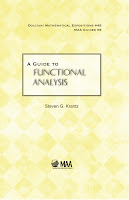 A Guide to Functional Analysis
is now available in the MAA Store!
Steven G. Krantz describes his new book below.
"Everyone knows that functional analysis is one of the most powerful tools
of twentieth-century mathematics. The idea of studying entire spaces
of functions, rather than just one function at a time, is both deep and original.
Yet it is difficult to get a glimpse of what this subject is really about, or
of how it works.
The Guide to Functional Analysis takes the neophyte reader and shows
him/her the basic concepts and rubric of this time-tested discipline. All the
major ideas are illustrated with concrete examples and applications to other
parts of mathematics. There are even some illustrations.
This is a user-friendly, hands-on introduction to an otherwise austere
and forbidding part of the mathematical lore. It will be helpful to students
beginning the long journey down the path to mastery of analysis and
also enlightening for any mathematician wanting to bone up on
linear operators and their uses. This book is meant to be a guide,
and we hope that it guides you to a pleasurable reading experience."
|
 Steven G. Krantz earned his B.A. degree for the University of California at Santa Cruz and his Ph.D. from Princeton University. He has written over 70 books and over 180 scholarly papers. The MAA has awarded him both the Beckenbach Book Prize and the Chauvenet Prize. Steven G. Krantz earned his B.A. degree for the University of California at Santa Cruz and his Ph.D. from Princeton University. He has written over 70 books and over 180 scholarly papers. The MAA has awarded him both the Beckenbach Book Prize and the Chauvenet Prize.
|
Friday, June 29, 2012
Beckenbach Book Prize
The Beckenbach Book Prize, established in 1986, is the successor to the MAA Book Prize established in 1982. It is named for the late Edwin Beckenbach, a long-time leader in the publications program of the Association and a well-known professor of mathematics at the University of California at Los Angeles. The Prize of $2,500 is intended to recognize the author(s) of a distinguished, innovative book published by the MAA and to encourage the writing of such books. The award is not given on a regularly scheduled basis.
Below are the most recent winners of the Beckenbach Book Prize. A full list of winners is available here.
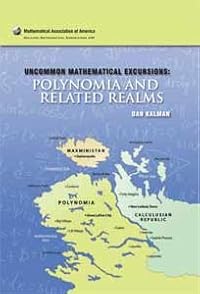
by Dan Kalman
This book presents an assortment of topics that extend the standard algebra-geometry-calculus curriculum of advanced secondary school and introductory college mathematics. It is intended as enrichment reading for anyone familiar with the standard curriculum, including teachers, scientists, engineers, analysts, and advanced students of mathematics.
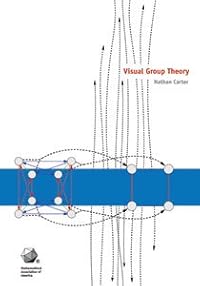
by Nathan Carter
Group theory is the branch of mathematics that studies symmetry, found in crystals, art, architecture, music, and many other contexts. Visual Group Theory assumes only a high school mathematics background and covers a typical undergraduate course in group theory from a thoroughly visual perspective. The more than 300 illustrations in Visual Group Theorybring groups, subgroups, homomorphisms, products, and quotients into clear view.
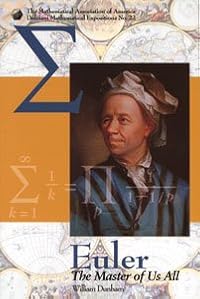
by William Dunham
Without question, Leonhard Euler (1707-1783) ranks among history's greatest mathematicians. Over six decades of unmatched productivity, and despite a visual impairment that grew ever worse, charted the course of mathematics throughout the eighteenth century and beyond. His reputation is captured in Laplace's famous admonition, "Read Euler, read Euler. He is the master of us all." Written for the mathematically literate reader, this book provides a glimpse of Euler in action.
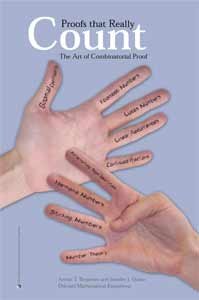
by Arthur Benjamin and Jennifer Quinn
Mathematics is the science of patterns, and mathematicians attempt to understand these patterns and discover new ones using a variety of tools. In Proofs That Really Count, award-winning math professors Arthur Benjamin and Jennifer Quinn demonstrate that many number patterns, even very complex ones, can be understood by simple counting arguments.
Subscribe to:
Posts (Atom)