 Mark Hunacek reviews A Guide to Functional Analysis by Steven G. Krantz as part of MAA Reviews.
"This book (barely over a hundred pages of text) is very short, even by the standards of this series, but nevertheless addresses most or all of the standard topics that one would expect to see in an introductory graduate-level semester in functional analysis, and perhaps even one or two things that might not get mentioned. More specifically, the first chapter starts with normed linear spaces, then defines Banach spaces and discusses the “big three” results typically associated with them (Uniform Boundedness, Open Mapping, Hahn-Banach). This is followed by chapters on the dual space, Hilbert space, the algebra of bounded linear operators on a Banach space (including a fairly lengthy section on compact operators), and Banach algebras. The author then generalizes things by discussing (chapter 6) arbitrary topological vector spaces. The four remaining chapters of the text discuss, in order, distributions, spectral theory (for bounded, particularly bounded normal, operators on a Hilbert space; some background in measure theory is needed for this chapter), convexity (including the Krein-Milman theorem), and fixed point theorems (the contraction mapping principle and the Schauder theorem)." Read the full review here. |

Showing posts with label Dolciani. Show all posts
Showing posts with label Dolciani. Show all posts
Friday, August 16, 2013
Mark Hunacek Reviews A Guide to Functional Analysis

Friday, April 26, 2013
New in the MAA eBooks Store
|
by Arthur Benjamin and Jennifer Quinn
is now available in the MAA eBooks Store!
Purchase your copy today for only $22.50.
Mathematics is the science of patterns, and mathematicians attempt to understand these patterns and discover new ones using a variety of tools. In Proofs That Really Count, award-winning math professors Arthur Benjamin and Jennifer Quinn demonstrate that many number patterns, even very complex ones, can be understood by simple counting arguments. The book explores more than 200 identities throughout the text and exercises, frequently emphasizing numbers not often thought of as numbers that count: Fibonacci Numbers, Lucas Numbers, Continued Fractions, and Harmonic Numbers, to name a few. Numerous hints and references are given for all chapter exercises and many chapters end with a list of identities in need of combinatorial proof. The extensive appendix of identities will be a valuable resource. This book should appeal to readers of all levels, from high school math students to professional mathematicians. Read the MAA Review written by Darren Glass, an associate professor at Gettysburg College, below. "Several years ago I attended a conference at which Arthur Benjamin, one of the authors of the book under review, gave a talk about Fibonacci Numbers. In particular, he gave the following interpretation. Let fn count the number of ways to tile an n-by-1 board with 1-by-1 square tiles and 2-by-1 domino tiles. One can show that fn = Fn+1, where Fn is the standard nth Fibonacci number defined by F0 = 0, F1 = 1, and the recursion relation Fn = Fn-1 + Fn-2. He proceeded to show how this definition could be used to give a combinatorial proof of many of the Fibonacci Number identities that we are familiar with, such as Fm+n=Fm+1Fn + FmFn-1..." Continue reading here. |

Friday, April 12, 2013
Now Available in the MAA Store
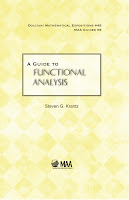 A Guide to Functional Analysis
is now available in the MAA Store!
Steven G. Krantz describes his new book below.
"Everyone knows that functional analysis is one of the most powerful tools
of twentieth-century mathematics. The idea of studying entire spaces
of functions, rather than just one function at a time, is both deep and original.
Yet it is difficult to get a glimpse of what this subject is really about, or
of how it works.
The Guide to Functional Analysis takes the neophyte reader and shows
him/her the basic concepts and rubric of this time-tested discipline. All the
major ideas are illustrated with concrete examples and applications to other
parts of mathematics. There are even some illustrations.
This is a user-friendly, hands-on introduction to an otherwise austere
and forbidding part of the mathematical lore. It will be helpful to students
beginning the long journey down the path to mastery of analysis and
also enlightening for any mathematician wanting to bone up on
linear operators and their uses. This book is meant to be a guide,
and we hope that it guides you to a pleasurable reading experience."
|
 Steven G. Krantz earned his B.A. degree for the University of California at Santa Cruz and his Ph.D. from Princeton University. He has written over 70 books and over 180 scholarly papers. The MAA has awarded him both the Beckenbach Book Prize and the Chauvenet Prize. Steven G. Krantz earned his B.A. degree for the University of California at Santa Cruz and his Ph.D. from Princeton University. He has written over 70 books and over 180 scholarly papers. The MAA has awarded him both the Beckenbach Book Prize and the Chauvenet Prize.
|
Friday, March 29, 2013
New Book: A Guide to Functional Analysis
by Steven G. Krantz |

Friday, March 22, 2013
Mark Hunacek reviews A Guide to Groups, Rings, and Fields
 Mark Hunacek reviews A Guide to Groups, Rings, and Fields by Fernando Gouvêa as an MAA review. Mark Hunacek reviews A Guide to Groups, Rings, and Fields by Fernando Gouvêa as an MAA review.
"The MAA Guide series — a subset of the Dolciani Mathematical Expositions — is rapidly becoming one of my favorite series of books. I like expository books that provide a quick and interesting entrée into an area of mathematics, or a useful source of examples, and that is precisely what these are. They are also, thanks to careful selection of authors, generally very well-written, informative and particularly useful as a resource for a varied audience. This book, the most recent one in the series (number 8, following books on complex variables, advanced real analysis, real variables, topology, elementary number theory, advanced linear algebra and plane algebraic curves) continues this tradition."
To read the whole review, click here.
To purchase a copy visit the MAA Store or the MAA eBooks Store.
|
Friday, March 1, 2013
Cheryl McAllister reviews Icons of Mathematics
 |
The following review of Icons of Mathematics by Claudi Alsina and Roger Nelsen was written by Cheryl J. McAllister in May 2012 as an MAA Review.
"Icons of Mathematics is #45 in the Dolciani Mathematical Expositions series, and it certainly lives up to the charge of the Dolciani series, providing highly readable discussions of a selection of 20 images that are as recognizable to the general public as they are to mathematicians. Each chapter focuses on one of the icons and includes a standard set of items: quotes from a wide variety of sources (Zhang Zai to Ralph Waldo Emerson), a short history of the figure including examples of uses of the image in mathematical and non-mathematical settings, examples of the figure in mathematical proofs of theorems or solutions to problems, and problems for the reader to solve..."
Read the full review here. |
Cheryl J. McAllister taught high school for 4 years and has been on the faculty of Southeast Missouri State for 20 years. Using what she learned as an undergraduate from her minor in art, she teaches a freshman seminar on “The Mathematics of Art.” You may contact her at: cjmcallister@semo.edu. |
|
Order you copy of Icons of Mathematics at the online MAA Store or the MAA eBooks Store. | |
Friday, February 1, 2013
Fernando Gouvêa on A Guide to Groups, Rings, and Fields
 Below, Fernando Gouvêa talks about his latest book, A Guide to Groups, Rings, and Fields. Below, Fernando Gouvêa talks about his latest book, A Guide to Groups, Rings, and Fields.When you write a book, people will often ask you why you did. It makes sense: writing a book takes time and effort, so something must have kept you going until you were done. In the case of my Guide to Groups, Rings, and Fields, I had a very good but not very interesting reason: someone asked me to do it, so I did. It was hard work indeed, but I had promised. It took about two years, with most of the work being done in the summer and at other times when school was not in session. Writing a book that is basically a survey with no proofs turned out to bring special difficulties. After all, if you state something wrongly in a typical mathematics book, you will discover your mistake as you (try to) write the proof. Here, however, I wasn't going to include proofs. I found myself depending heavily on other books by authors I trust and trying hard to check everything. (There are probably still many mistakes, of course. Find some and let me know.) In many cases I tried to say something about why things work as they do, giving “shadows of proofs.” In some cases, a shadow is all one needs to reconstruct the proof, but for the big theorems that is far from true. The other thing I decided to do was to ignore the logical development. This was, after all, a book intended for after taking a course, so it was safe to assume my reader knew more than what I had done at that point. That meant making sure I had a good index, so people could look up things if they needed to. I hope I did that successfully. Was it fun? Sometimes it was. It was neat to spend time sorting out the many different definitions of “separable extension” and figuring out how to explain them. I enjoyed making decisions about messy nomenclature. For example, what is a “semisimple” ring? Some authors define it in a way that allows rings to be simple but not semisimple, which is a little annoying. I ended up deciding I could live with that, but put in a note explaining the issue. At other times, for example when I was making the index, it was just hard work. At those times what kept me going was the hope that the result would be worthwhile and useful. But that’s really up to my readers to judge. All I can do is to hope they like it. A Guide to Groups, Rings, and FieldsIn addition to the standard material on groups, rings, modules, fields, and Galois theory, the book includes discussions of other important topics that are often omitted in the standard graduate course, including linear groups, group representations, the structure of Artinian rings, projective, injective and flat modules, Dedekind domains, and central simple algebras. All of the important theorems are discussed, without proofs but often with a discussion of the intuitive ideas behind those proofs. Those looking for a way to review and refresh their basic algebra will benefit from reading this Guide, and it will also serve as a ready reference for mathematicians who make use of algebra in their work. Purchase this book today at the MAA Store or at the MAA eBooks Store |
Friday, January 25, 2013
New Book: New Horizons in Geometry
 New Horizons in Geometry
by Tom Apostol and Mamikon Mnatsakanian Dolciani Mathematical Expositions Series New Horizons in Geometry represents the fruits of 15 years of work in geometry by a remarkable team of prize-winning authors—Tom Apostol and Mamikon Mnatsakanian. It serves as a capstone to an amazing collaboration. Apostol and Mamikon provide fresh and powerful insights into geometry that requires only modest background in mathematics. Using new and intuitively rich methods, they give beautifully illustrated proofs of results, the majority of which are new, and frequently develop extensions of familiar theorems that are often surprising and sometimes astounding. It is mathematical exposition of the highest order. The hundreds of full color illustrations by Mamikon are visually enticing and provide great motivation to read further and savor the wonderful results. Lengths, areas, and volumes of curves, surfaces, and solids are explored from a visually captivating perspective. It is an understatement to say that Apostol and Mamikon have breathed new life into geometry. |
Available now in the MAA Store.
Friday, December 21, 2012
New Book: A Guide to Groups, Rings, and Fields
|
A Guide to Group, Rings, and Fields by Fernando Q. Gouvêa This Guide offers a concise overview of the theory of groups, rings, and fields at the graduate level, emphasizing those aspects that are useful in other parts of mathematics. It focuses on the main ideas and how they hang together. It will be useful to both students and professionals. In addition to the standard material on groups, rings, modules, fields, and Galois theory, the book includes discussions of other important topics that are often omitted in the standard graduate course, including linear groups, group representations, the structure of Artinian rings, projective, injective and flat modules, Dedekind domains, and central simple algebras. All of the important theorems are discussed, without proofs but often with a discussion of the intuitive ideas behind those proofs. Those looking for a way to review and refresh their basic algebra will benefit from reading this Guide, and it will also serve as a ready reference for mathematicians who make use of algebra in their work. Available in the MAA Store and the MAA eBooks Store.
|
Subscribe to:
Posts (Atom)