Showing posts with label New. Show all posts

Friday, May 8, 2015

Now in Print! The Heart of Calculus

The Heart of Calculus: Explorations and Applications
Philip M. Anselone and John W. Lee
List Price: $60.00 | MAA Member Price: $48.00

This book contains enrichment material for courses in first and second year calculus, differential equations, modeling, and introductory real analysis. It targets talented students who seek a deeper understanding of calculus and its applications. The book can be used in honors courses, undergraduate seminars, independent study, capstone courses taking a fresh look at calculus, and summer enrichment programs. The book develops topics from novel and/or unifying perspectives. Hence, it is also a valuable resource for graduate teaching assistants developing their academic and pedagogical skills and for seasoned veterans who appreciate fresh perspectives.

The explorations, problems, and projects in the book impart a deeper understanding of and facility with the mathematical reasoning that lies at the heart of calculus and conveys something of its beauty and depth. A high level of rigor is maintained. However, with few exceptions, proofs depend only on tools from calculus and earlier. Analytical arguments are carefully structured to avoid epsilons and deltas. Geometric and/or physical reasoning motivates challenging analytical discussions. Consequently, the presentation is friendly and accessible to students at various levels of mathematical maturity. Logical reasoning skills at the level of proof in Euclidean geometry suffice for a productive use of the book.

There are 16 chapters in the book, divided about equally between pure and applied mathematics. The first three chapters are on fundamentals of differential calculus and the last three are on the monumental discoveries of Newton and Kepler on celestial motion and gravitation. The intervening chapters present significant topics in pure and applied mathematics chosen for their intrinsic interest, historical influence, and continuing importance. There is great flexibility in the choice of which chapters to cover and the order of coverage because chapters are essentially independent of each other.

Friday, December 5, 2014

New: How Euler Did Even More


How Euler Did Even More

By C. Edward Sandifer
Spectrum Series

"Read Euler, read Euler, he is master of us all," LaPlace exhorted us. And it is true, Euler writes with unerring grace and ease. He is exceptionally clear thinking and clear speaking. It is a joy and a pleasure to follow him. It is especially so with Ed Sandifer as your guide. Sandifer has been studying Euler for decades and is one of the world's leading experts on his work. This volume is the second collection of Sandifer's "How Euler Did It" columns. Each is a jewel of historical and mathematical exposition. The sum total of years of work and study of the most prolific mathematician of history, this volume will leave you marveling at Euler's clever inventiveness and Sandifer's wonderful ability to explicate and put it all in context.

Pick up your copy today at the MAA Store!

Prefer an ebook? Visit the MAA eBooks Store.

Friday, August 15, 2014

MAA Books Beat: Teaching Isn't the Only Job for Math Majors

Written by Steve Kennedy, MAA Books Beat is a column written for MAA FOCUSTeaching Isn't the Only Job for Math Majors appears in the August/September issue.

Teaching Isn’t the Only Job for Math Majors

“What would I do with a math degree? I don’t want to teach.” That anyone would ask this question has flummoxed me for years. When I was younger I was tempted (and sometimes succumbed to the temptation) to explain that one does not study mathematics for its possible future income potential. One studies mathematics because it is mankind’s only portal to absolute truth. Science deals in, as its best, approximations to truth; the humanities in speculation; the arts obscure as much as they reveal. Mathematics, using just the power of your mid, reveals eternal, and external to us, absolute truth.

I’m older now, and hopefully wiser, and not only do I see the value in what science, humanities, and the arts illuminate, but also, I see the legitimacy of the question itself. I too can now talk about the many interesting careers my former students have taken up: Nutty Steph, who started a granola company; Kate, who became a dog-musher leading winter tours of northern Minnesota; Liz, who was Stephen Wolfram’s personal assistant. Unfortunately, as the examples illustrate, I tend to remember the unusual and offbeat options.

Details about “Best Job”


CareerCast recently listed “mathematician” as the Best Job of 2014 (university professor, statistician, and actuary round out the top four). This made a nice blurb in our department newsletter, but they didn’t provide an awful lot of detail about what kind of jobs these folks are looking at. Fortunately, we have Andy Sterrett. Andy has been tracking down mathematics graduates with interesting careers and compiling their stories in 101 Careers in Mathematics for more than a decade. The third edition is just out. I’ll give some highlights to share with your students wondering what to do with a math degree.

Alysia Appell has degrees from Grand Valley State University and Rensselaer Polytechnic Institute. She is in charge of the pilot-staffing model for Northwest/Delta Airlines; that means she needs to forecast the airline’s future needs to hire pilots and plan how to cover all flights given predicted vacations and illnesses of current flight staff.

Joel Schneider has degrees from Franklin and Marshall, Washington State, and the University of Oregon. He was the content director for Square One TV, a children’s TV show that aired in the 1990s. Square One has echoes of Sesame Street but was focused on mathematics. My personal favorite bit was “Mathnet,” a Dragnet parody that featured a detective named Monday who was interested in just the facts as she solved mathematical mysteries. Schneider is still in TV, now producing a mathematical game show called Risky Numbers.

Kay Strain King has degrees from Vanderbilt, Makerere (Uganda), and Texas A&M universities. She is a senior environmental mathematician for Theta Engineering. She does mathematical consulting on environmental problems. In her article in 101 Careers, she describes a project to model gas release from a bermed storage tank under various weather conditions.

I bought a copy of 101 Careers to put in our department’s student reading nook. I’m thinking I should buy another copy for my desk. If you teach and advise undergraduates and sometimes find yourself confronting the question with which I opened this column, you should buy one as well.

(By the way, we have already started collecting material for the next edition of 101 Careers. If you are, or know, someone with an interesting mathematical career, please contact Deanna Haunsperger at dhaunspe@carleton.edu.)

Monday, July 7, 2014

New: Mathematicians on Creativity

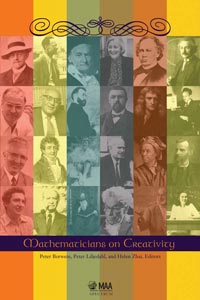
Mathematicians on Creativity

Peter Borwein, Peter Liljedahl, and Helen Zhai, Editors

This book aims to shine a light on some of the issues of mathematical creativity. It is neither a philosophical treatise nor the presentation of experimental results, but a compilation of reflections from top-caliber working mathematicians. In their own words, they discuss the art and practice of their work. This approach highlights creative components of the field, illustrates the dramatic variation by individual, and hopes to express the vibrancy of creative minds at work. Mathematicians on Creativity is meant for a general audience and is probably best read by browsing.


Friday, May 30, 2014

Coming Soon: Mathematicians on Creativity

Mathematicians on Creativity

Peter Borwein, Peter Liljedahl, and Helen Zhai, Editors
Spectrum

This book aims to shine a light on some of the issues of mathematical creativity. It is neither a philosophical treatise nor the presentation of experimental results, but a compilation of reflections from top-caliber working mathematicians. In their own words, they discuss the art and practice of their work. This approach highlights creative components of the field, illustrates the dramatic variation by individual, and hopes to express the vibrancy of creative minds at work.  Mathematicians on Creativity is meant for a general audience and is probably best read by browsing.

Catalog Code: MCT
ISBN: 978-0-88385-574-4
Paperbound, 220 pp.


Friday, May 16, 2014

New eBook: Game Theory through Examples

Game Theory through Examples

by Erich Prisner
Classroom Resource Materials


Game Theory through Examples is a thorough introduction to elementary game theory, covering finite games with complete information.

The core philosophy underlying this volume is that abstract concepts are best learned when encountered first (and repeatedly) in concrete settings. Thus, the essential ideas of game theory are here presented in the context of actual games, real games much more complex and rich than the typical toy examples. All the fundamental ideas are here: Nash equilibria, backward induction, elementary probability, imperfect information, extensive and normal form, mixed and behavioral strategies. The active-learning, example-driven approach makes the text suitable for a course taught through problem solving. Students will be thoroughly engaged by the extensive classroom exercises, compelling homework problems and nearly sixty projects in the text. Also available are approximately eighty Java applets and three dozen Excel spreadsheets in which students can play games and organize information in order to acquire a gut feeling to help in the analysis of the games. Mathematical exploration is a deep form of play, that maxim is embodied in this book.

Friday, May 9, 2014

New in the MAA Store: Ordinary Differential Equations

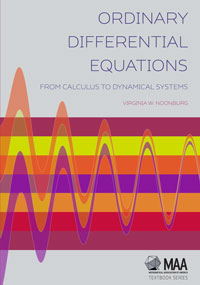
Ordinary Differential Equations: From Calculus to Dynamical Systems
By Virginia W. Noonburg
List Price: $60.00
MAA Member: $48.00

This book presents a modern treatment of material traditionally covered in the sophomore-level course in ordinary differential equations. While this course is usually required for engineering students the material is attractive to students in any field of applied science, including those in the biological sciences.

The standard analytic methods for solving first and second-order differential equations are covered in the first three chapters. Numerical and graphical methods are considered, side-by-side with the analytic methods, and are then used throughout the text. An early emphasis on the graphical treatment of autonomous first-order equations leads easily into a discussion of bifurcation of solutions with respect to parameters.

The fourth chapter begins the study of linear systems of first-order equations and includes a section containing all of the material on matrix algebra needed in the remainder of the text. Building on the linear analysis, the fifth chapter brings the student to a level where two-dimensional nonlinear systems can be analyzed graphically via the phase plane. The study of bifurcations is extended to systems of equations, using several compelling examples, many of which are drawn from population biology. In this chapter the student is gently introduced to some of the more important results in the theory of dynamical systems. A student project, involving a problem recently appearing in the mathematical literature on dynamical systems, is included at the end of Chapter 5.

A full treatment of the Laplace transform is given in Chapter 6, with several of the examples taken from the biological sciences. An appendix contains completely worked-out solutions to all of the odd-numbered exercises.

The book is aimed at students with a good calculus background that want to learn more about how calculus is used to solve real problems in today's world. It can be used as a text for the introductory differential equations course, and is readable enough to be used even if the class is being "flipped." The book is also accessible as a self-study text for anyone who has completed two terms of calculus, including highly motivated high school students. Graduate students preparing to take courses in dynamical systems theory will also find this text useful.

Order your copy today in the MAA Store.

Friday, March 14, 2014

New eBook: Textbooks, Testing, Training: How We Discourage Thinking

Textbooks, Testing, Training: How We Discourage Thinking

by Stephen S. Willoughby

Willoughby's essay is a gem. It should be in the hands of every young teacher. I wish that I had read it many years ago. I have no doubt that many of his observations and the information he imparts will remain with me for a while. I certainly hope so. A collection of reminiscences from other teachers with their valuable insights and experiences (who could write with such expertise as he does) would make a fine addition to the education literature.
— James Tattersall, Providence College

Steven S. Willoughby has taught mathematics for 59 years and he has seen everything. Some of it has annoyed him, some has inspired him. This little book is something of a valedictory and he shares some parting thoughts as he contemplates the end of his teaching career. Steve has strong, cogent and mostly negative opinions about textbooks, standardized testing, and teacher training. These opinions have been forged in the cauldron of the classroom of a deeply caring teacher. They might not please you, but they ought to make you think. They should spark needed debate in our community. Ultimately this is a human tale with rough parallels to Hardy's Apology; replace "Mathematician's" with "Teacher's" perhaps. Every teacher will sympathize with Steve's frustrations and empathize with the humanity and compassion that animated his life's work and that beat at the center of this book.

Order your copy today in the MAA eBooks Store.
(PDF: $11.00,  POD: $18.00)


Friday, March 7, 2014

New in the MAA Store

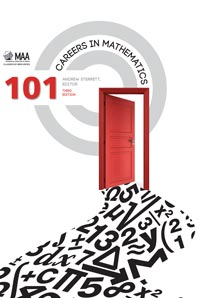
101 Careers in Mathematics

3rd Edition
Andrew Sterret, Editor

This third edition of the immensely popular 101 Careers in Mathematics contains updates on the career paths of individuals profiled in the first and second editions, along with many new profiles. No career counselor should be without this valuable resource.

The authors of the essays in this volume describe a wide variety of careers for which a background in the mathematical sciences is useful. Each of the jobs presented shows real people in real jobs. Their individual histories demonstrate how the study of mathematics was useful in landing well-paying jobs in predictable places such as IBM, AT&T, and American Airlines, and in surprising places such as FedEx Corporation, L.L. Bean, and Perdue Farms, Inc. You will also learn about job opportunities in the Federal Government as well as exciting careers in the arts, sculpture, music, and television. There are really no limits to what you can do if you are well prepared in mathematics.

The degrees earned by the authors profiled here range from bachelor’s to master’s to PhD in approximately equal numbers. Most of the writers use the mathematical sciences on a daily basis in their work. Others rely on the general problem-solving skills acquired in mathematics as they deal with complex issues.

Order your copy today at the MAA Store

Friday, December 13, 2013

New MAA eBook

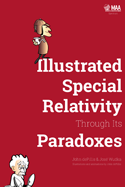
Illustrated Special Relativity Through Its Paradoxes
A Fusion of Linear Algebra, Graphics, and Reality
by John dePillis and José Wudka

Illustrated Special Relativity illustrates and resolves several apparent paradoxes of special relativity including the twin paradox and train-and-tunnel paradox. Assuming a minimum of technical prerequisites the authors introduce inertial frames and use them to explain a variety of phenomena: the nature of simultaneity, the proper way to add velocities, and why faster-than-light travel is impossible. Most of these explanations are contained in the resolution of apparent paradoxes, including some lesser-known ones: the pea-shooter paradox, the bug-and-rivet paradox, and the accommodating universe paradox. The explanation of time and length contraction is especially clear and illuminating.

At the outset of his seminal paper on special relativity, Einstein acknowledges the work of James Clerk Maxwell whose four equations unified the theories of electricity, optics, and magnetism. For this reason, the authors develop Maxwell’s equations which lead to a simple calculation for the frame-independent speed of electromagnetic waves in a vacuum. (Maxwell did not realize that light was a special case of electromagnetic waves.) Several chapters are devoted to experiments of Roemer, Fizeau, and de Sitter to measure the speed of light and the Michelson-Morley experiment abolishing the aether.

Throughout the exposition is thorough, but not overly technical, and often illustrated by cartoons. The volume might be suitable for a one-semester general-education introduction to special relativity. It is especially well-suited to self-study by interested laypersons or use as a supplement to a more traditional text.

Purchase your copy today in the MAA eBooks Store.

Friday, October 18, 2013

New in the MAA Store

Now available in print at the MAA Store.

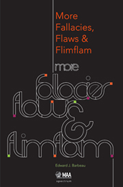
More Fallacies, Flaws & Flimflam

by Edward J. Barbeau
Spectrum Series

More Fallacies, Flaws, and Flimflam is the second volume of selections drawn mostly from The College Mathematics Journal column “Fallacies, Flaws, and Flimflam” from 2000 through 2008. More Fallacies, Flaws, and Flimflam contains items ranging from howlers (outlandish procedures that nonetheless lead to a correct answer) to deep or subtle errors often made by strong students.

Friday, October 11, 2013

More Fallacies, Flaws and Flimflam

More Fallacies, Flaws and Flimflam More Fallacies, Flaws and Flimflam by Edward J. Barbeau is now available in the MAA eBooks Store. A paperback version will be available in the MAA Store soon.

Here is another collection of Fallacies, Flaws and Flimflam, mostly drawn from the column of this name in The College Mathematics Journal between 2000 and 2008. As in the first volume, there is a variety of items ranging from howlers (outlandish procedures that nonetheless lead to a correct answer) to errors that are deep or subtle often made by strong students. While some are provided for entertainment, others offer a challenge to the reader to determine exactly where things go wrong.

There are many proposals to improve the quality of mathematics education, but they seldom address the need for students to pay careful attention to what they do and to check their work. It is through an engagement with meaning that students can avoid the pitfalls that come too naturally. Accordingly, this volume should be useful to teachers at all levels by giving them examples of flawed work they can use in the classroom. Encouraging students to find where someone else went wrong may help them avoid similar errors in the future.

The items are sorted according to subject matter. Elementary teachers will not find much of use beyond Chapter 1, while middle and secondary teachers will find items in Chapters 1, 2, 3, 7, 8 that they might use. College teachers should find material in every part of the book.

The mathematical topics covered include arithmetic, algebra, trigonometry, geometry, combinatorics, probability, and calculus.

Friday, September 13, 2013

New in the MAA eBooks Store

Check out some of these MAA books now available as ebooks!

To order, visit the MAA eBooks Store.


Linear Algebra Problem BookLinear Algebra Problem Book

By Paul R. Halmos

PDF Price: $23.00
POD Price: $51.00

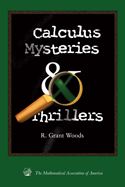
Calculus Mysteries and ThrillersCalculus Mysteries and Thrillers

By R. Grant Woods

PDF Price: $18.00
POD Price: $33.00

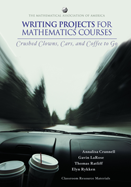
Writing Projects for Mathematics CoursesWriting Projects for Mathematics Courses

By Annalisa Crannell, Gavin LaRose, Thomas Ratliff, and Elyn Rykkens

PDF Price: $22.00
POD Price: $35.00

Great Moments in Mathematics Before 1650Great Moments in Mathematics Before 1650

By Howard Eves

PDF Price: $20.00
POD Price: $45.00

Great Moments in Mathematics After 1650Great Moments in Mathematics After 1650

By Howard Eves

PDF Price: $20.00

Friday, July 19, 2013

New MAA Website

Have you checked out MAA's new website?

Be sure to check out the books and eBooks sections of the website, where we are creating individual pages to provide more information on each of our books.

Friday, July 12, 2013

New in the MAA eBooks Store

Undergraduate Mathematics for the Life Sciences: Models, Processes, and DirectionsUndergraduate Mathematics for the Life Sciences: Models, Processes, and Directions
Glenn Ledder, Jenna P. Carpenter, Timothy D. Comar, Editors
MAA Notes

In this volume, authors from a variety of institutions address some of the problems involved in reforming mathematics curricula for biology students. The problems are sorted into three themes: Models, Processes, and Directions. It is difficult for mathematicians to generate curriculum ideas for the training of biologists so a number of the curriculum models that have been introduced at various institutions comprise the Models section. Processes deals with taking that great course and making sure it is institutionalized in both the biology department (as a requirement) and in the mathematics department (as a course that will live on even if the creator of the course is no longer on the faculty). Directions looks to the future, with each paper laying out a case for pedagogical developments that the authors would like to see.
Applications of Mathematics in Economics Applications of Mathematics in Economics
Warren Page, Editor
MAA Notes

Applications of Mathematics in Economics presents an overview of the (qualitative and graphical) methods and perspectives of economists. Its objectives are not intended to teach economics, but rather to give mathematicians a sense of what mathematics is used at the undergraduate level in various parts of economics, and to provide students with the opportunities to apply their mathematics in relevant economics contexts.

The volume’s applications span a broad range of mathematical topics and levels of sophistication. Each article consists of self-contained, stand-alone, expository sections whose problems illustrate what mathematics is used, and how, in that subdiscipline of economics. The problems are intended to be richer and more informative about economics than the economics exercises in most mathematics texts. Since each section is self-contained, instructors can readily use the economics background and worked-out solutions to tailor (simplify or embellish) a section’s problems to their students’ needs. Overall, the volume’s 47 sections contain more than 100 multipart problems. Thus, instructors have ample material to select for classroom uses, homework assignments, and enrichment activities.
Purchase these books today in the MAA eBooks Store.

Friday, June 28, 2013

Now in the MAA Store

Learning Modern Algebra Learning Modern Algebra: From Early Attempts to Prove Fermat's Last Theorem
by Al Cuoco and Joseph J. Rotman

Learning Modern Algebra aligns with the CBMS Mathematical Education of Teachers–II recommendations, in both content and practice. It emphasizes rings and fields over groups, and it makes explicit connections between the ideas of abstract algebra and the mathematics used by high school teachers. It provides opportunities for prospective and practicing teachers to experience mathematics for themselves, before the formalities are developed, and it is explicit about the mathematical habits of mind that lie beneath the definitions and theorems.

This book is designed for prospective and practicing high school mathematics teachers, but it can serve as a text for standard abstract algebra courses as well. The presentation is organized historically: the Babylonians introduced Pythagorean triples to teach the Pythagorean theorem; these were classified by Diophantus, and eventually this led Fermat to conjecture his Last Theorem. The text shows how much of modern algebra arose in attempts to prove this; it also shows how other important themes in algebra arose from questions related to teaching. Indeed, modern algebra is a very useful tool for teachers, with deep connections to the actual content of high school mathematics, as well as to the mathematics teachers use in their profession that doesn't necessarily “end up on the blackboard.''

Order your copy today in the MAA Store!
List Price: $60.00
MAA Member: $48.00

Beyond the Quadratic Formula Beyond the Quadratic Formula
by Ron Irving

The quadratic formula for the solution of quadratic equations was discovered independently by scholars in many ancient cultures and is familiar to everyone. Less well known are formulas for solutions of cubic and quartic equations whose discovery was the high point of 16th century mathematics. Their study forms the heart of this book, as part of the broader theme that a polynomial’s coefficients can be used to obtain detailed information on its roots. The book is designed for self-study, with many results presented as exercises and some supplemented by outlines for solution. The intended audience includes in-service and prospective secondary mathematics teachers, high school students eager to go beyond the standard curriculum, undergraduates who desire an in-depth look at a topic they may have unwittingly skipped over, and the mathematically curious who wish to do some work to unlock the mysteries of this beautiful subject.

Order your copy today in the MAA Store!
List Price: $55.00
MAA Member: $44.00

Friday, June 14, 2013

New in the MAA eBooks Store

Order your copies today in the MAA eBooks Store.
Learning Modern Algebra
Learning Modern Algebra: From Early Attempts to Prove Fermat's Last Theorem
by Al Cuoco and Joseph J. Rotman
MAA Textbooks Series

Learning Modern Algebra aligns with the CBMS Mathematical Education of Teachers-II recommendations, in both content and practice. It emphasizes rings and fields over groups, and it makes explicit connections between the ideas of abstract algebra and the mathematics used by high school teachers. It provides opportunities for prospective and practicing teachers to experience mathematics for themselves, before the formalities are developed, and it is explicit about the mathematical habits of mind that lie beneath the definitions and theorems.

Learning Modern Algebra is designed for college students who want to teach mathematics in high school, but it can serve as a text for standard abstract algebra courses as well.

(Print version coming soon to the MAA Store.)
Beyond the Quadratic Formula
by Ron Irving
Classroom Resource Materials Series

Beyond the Quadratic Formula is designed for self-study, with many results presented as exercises and some supplemented by outlines for solution. The intended audience includes in-service and prospective secondary mathematics teachers, high school students eager to go beyond the standard curriculum, undergraduates who desire an in-depth look at a topic they may have unwittingly skipped over, and the mathematically curious who wish to do some work to unlock the mysteries of this beautiful subject.

(Print version coming soon to the MAA Store.)
New Horizons in Geometry
by Tom M. Apostol and Mamikon A. Mnatsakanian
Dolciani Mathematical Expositions Series

Apostol and Mamikon provide fresh and powerful insights into geometry that requires only a modest background in mathematics.Using new and intuitively rich methods, they give beautifully illustrated proofs of results, the majority of which are new, and frequently develop extensions of familiar theorems that are often surprising and sometimes astounding. It is mathematical exposition of the highest order.


Use the code 1689472568 to receive 10% off your book purchase in the MAA eBooks Store!

Friday, June 7, 2013

New Material in Calculus and Its Origins

Calculus and Its OriginsCalculus and Its Origins now includes material on the origins of differential equations! The author, Dave Perkins, explains how he gathered the information with the help of his colleagues below.

"In the months after Calculus & Its Origins was initially printed, I gradually grew sorry that I had not included any material concerning the origins of differential equations. It's my understanding that calculus was born not only out of pure curiosity but also, more importantly, out of the desire to quantify scientific observations. Differential equations are the calculus-based expression of such observations.

When I learned that the book would be reprinted, I eagerly asked for permission to include a few pages on the subject. The MAA folks graciously agreed. On the very day I asked, I opened the March 2013 College Mathematics Journal to the article "Who solved the Bernoulli differential equation and how did they do it?" by Adam Parker. What amazing luck! Even better, Adam agreed to talk to me on the phone, whereupon he helped me to sort out my ideas for the new material I wished to include in the second printing.

I eventually chose several of the earliest differential equations to outline as exercises (all exercises in the book are extended outlines of some historically important result, rather than being simply lists of practice questions). The first exercise describes Descartes's solution to a problem posed to him by Florimund de Beaune, a man of many interests whose differential equation related to the behavior of sound. The other problems concern equations posed by two of the Bernoulli brothers.

Time was short, so I posted a plea for help to my Project NExT email group, wondering if perhaps a person or two could look at my first draft of these problems over the ensuing 36 hours. Not only did I get immediate offers, but two group members cross-posted my request to other lists. Soon I had a dozen confirmed helpers who committed to my quick time frame.

The offers kept coming, and I told each person that I had plenty of help, but would send them my material if they'd like to see it nevertheless. Every one said, "Please do send the problems. I'd like to see them!" To me, this testifies to both a widespread love for the history of mathematics and the collegiality that I have always encountered among mathematicians. This warmth and this curiosity are what prompted me to ask if I could write this blog post, to share my feel-good story and publicly say thank you.

My colleagues who reacted so quickly and in such caring detail to my new material are now listed in the preface of the second edition, but I want to thank them again. They are Adam Parker, Jennifer Daniel, William Dunham, Melissa Hoover, Lynne Ipina, Dan Kemp, Will Murray, and Fred Rickey.

My thanks as well to Carol Baxter and Beverly Ruedi at the MAA for their efforts in including the new material."


Purchase your copy today at the MAA Store or the MAA eBooks Store.

Friday, May 31, 2013

Now Available in the MAA Store

Exploring Advanced Euclidean Geometry with GeoGebra

Exploring Advanced Euclidean Geometry with GeoGebra by Gerard A. Venema is now available in the MAA Store.

The geometry we study in school was mostly discovered in ancient times and was systematized by the Greek mathematician Euclid of Alexandria in around 300BC. The subject of Euclidean geometry has continued to expand in the years since Euclid did his work. Many beautiful and amazing new discoveries that build on the geometry of Euclid have been made by a variety of people.

In this book, easy-to-use dynamic geometry software is employed to explore some of those newer results. The reader is guided to discover the theorems, to develop a deep understanding of them, and to come to appreciate them for their elegance and beauty as well as for their utility.


Purchase your copy today!
List price: $50.00
MAA Member Price: $40.00