| Dr. Japheth Wood discusses his favorite NML books. "When I was in high school I would spend my free periods in the math department office. One of the treasures I found there was a fairly complete set of books from the Anneli Lax New Mathematical Library that was hidden behind another row of books, and must have been untouched for at decade. I vividly remember reading Coxeter and Greitzer's Geometry Revisited, Ivan Niven's Numbers: Rational and Irrational, and Grossman and Madnus's Groups and their Graphs. Those books really opened my mathematical brain, and had a big impact on my development as a mathematician." |
||
 Geometry Revisited Geometry Revisitedby H.S.M. Coxeter and S.L. Greitzer |  Numbers: Rational and Irrational Numbers: Rational and Irrationalby Ivan Niven |  Groups and their Graphs Groups and their Graphsby Israel Grossman and Wilhem Madnus |
Japheth Wood, Ph.D. is a mathematician at the Bard Master of Arts Teaching Program and Executive Director of New York Math Circle. | ||

Showing posts with label MAA Books. Show all posts
Showing posts with label MAA Books. Show all posts
Friday, April 5, 2013
My Favorite NML Books

Friday, March 29, 2013
New Book: A Guide to Functional Analysis
by Steven G. Krantz |

Friday, March 22, 2013
Mark Hunacek reviews A Guide to Groups, Rings, and Fields
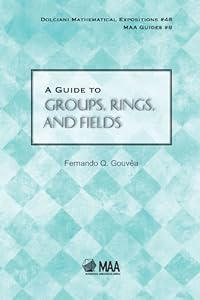 Mark Hunacek reviews A Guide to Groups, Rings, and Fields by Fernando Gouvêa as an MAA review. Mark Hunacek reviews A Guide to Groups, Rings, and Fields by Fernando Gouvêa as an MAA review.
"The MAA Guide series — a subset of the Dolciani Mathematical Expositions — is rapidly becoming one of my favorite series of books. I like expository books that provide a quick and interesting entrée into an area of mathematics, or a useful source of examples, and that is precisely what these are. They are also, thanks to careful selection of authors, generally very well-written, informative and particularly useful as a resource for a varied audience. This book, the most recent one in the series (number 8, following books on complex variables, advanced real analysis, real variables, topology, elementary number theory, advanced linear algebra and plane algebraic curves) continues this tradition."
To read the whole review, click here.
To purchase a copy visit the MAA Store or the MAA eBooks Store.
|
Friday, March 8, 2013
My Favorite NML Book: An Introduction to Inequalities
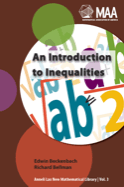 Dr. Timothy G. Feeman, a mathematics professor at Villanova University, discusses his favorite Anneli Lax New Mathematical Library book. Dr. Timothy G. Feeman, a mathematics professor at Villanova University, discusses his favorite Anneli Lax New Mathematical Library book."Among the slender, inviting volumes in the Anneli Lax New Mathematical Library (NML) series, one that appeals to my analytical bent and continues to provide food for thought is An Introduction to Inequalities, by Edwin Beckenbach and Richard Bellman. After a full 40 pages of discussion of the meaning of the “greater than” symbol, the order relation on the real number system, and everything you wish your Advanced Calculus students knew about absolute values comes the first main theme of the book: the inequality of the arithmetic and geometric means. The treatment builds inevitably and meticulously from the AMGM inequality for two numbers to the general version for n numbers, culminating in the demonstration of Young’s inequality. The Cauchy inequality is the second theme, and the two themes together lead us to the discovery of the three big inequalities for metric spaces: Hӧlder, Minkowski, and the triangle inequality. An iteration of the AMGM inequality due to Gauss leads us to the verge of the study of elliptic functions. In keeping with the nature of the NML series, all of this is done without any mention of Calculus. Geometric interpretations of the inequalities get their full due attention. The reward for our efforts comes in the treatment of max/min problems, still without Calculus of course, in Chapter 5. The problem of “the wealthy football player”, who wishes to have his rectangular coffin interred in an ellipsoidal crypt, is a real treat. The book wraps up with a wonderful little introduction to metric spaces, including a proof that the unit disc in a metric space must be convex and symmetric about the origin. Inequalities are the bread and butter of analysis; this book is like wholesome multi-grain bread spread with the freshest creamery butter. Dig in!"
To purchase An Introduction to Inequalities, visit the MAA eBooks Store.
|
Friday, February 22, 2013
William Satzer reviews Explorations in Complex Analysis
| The following review of Explorations in Complex Analysis by William Satzer was published as an MAA Review in December 2012.
"This new offering from the MAA is a collection of six inducements or invitations to further research for undergraduates with some background in complex analysis. The book is flexible enough to be a source of enrichment material, a basis for research projects, the kernel of a capstone course, or just a tool to ignite the interest of the mathematically curious..."
Read the full review here. |
 |
| William Satzer is a senior intellectual property scientist at 3M Company, having previously been a lab manager at 3M for composites and electromagnetic materials. His training is in dynamical systems and particularly celestial mechanics; his current interests are broadly in applied mathematics and the teaching of mathematics. |
|
| Buy your copy of Explorations in Complex Analysis today at the MAA Store or MAA eBooks Store. | |
Last week to receive 10% off your entire purchase in the MAA eBooks Store. Use the coupon code 1507664649. Offer expires February 28, 2013 |
|
Friday, February 15, 2013
Top Selling MAA Books of 2012
| Check out the bestselling MAA books of 2012. | ||
MAA Best Sellers in Print |
||
 1. Math Through the Ages by William P. Berlinghoff & Fernando Q. Gouvêa |
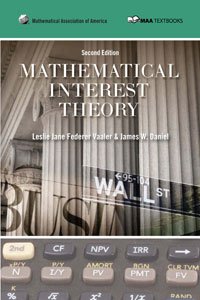 2. Mathematical Interest Theory, 2nd Ed. by Leslie Jane Federer Vaaler & James W. Daniel |
 3. Game Theory and Strategy by Philip D. Straffin |
| 4. Functions, Datas and Models: An Applied Approach to College Algebra by Sheldon P. Gordon & Florence S. Gordon 5. Mathematics for Secondary School Teachers by E. Bremigan, R. Bremigan, & J. Lorch 6. Combinatorics: A Guided Tour by David Mazur 7. The Mathematics of Games and Gambling, 2nd Ed. by Edward Packel 8. Calculus and It's Origins by David Perkins 9. Beautiful Mathematics by Martin Erikson 10. Expeditions in Mathematics edited by T. Shubin, D. Hayes, & G. Alexanderson |
||
MAA Best Sellers on Amazon.com |
||
 1. First Steps for Math Olympians by J. Douglas Faires |
2. Mathematical Interest Theory, 2nd Ed. by Leslie Jane Federer Vaaler & James W. Daniel |
3. Geometry Revisited by H.S.M. Coxeter & S. L. Greitzer |
| 4. Math Through the Ages by William P. Berlinghoff & Fernando Q. Gouvêa 5. Euler: Master of Us All by William Dunham 6. Game Theory and Strategy by Philip D. Straffin 7. Visual Group Theory by Nathan Carter 8. The Contest Problem IX edited by David Wells & J. Douglas Faires 9. Mathematical Interest Theory Student Solutions Manual by Leslie Jane Federer Vaaler 10. The Contest Problem Book VIII edited by J. Douglas Faires & David Wells |
||
MAA Best Sellers via Cambridge University Press |
||
1. Mathematical Interest Theory, 2nd Ed. by Leslie Jane Federer Vaaler & James W. Daniel |
2. Geometry Revisited by H.S.M. Coxeter & S. L. Greitzer |
 3. Beautiful Mathematics by Martin Erickson |
| 4. Math Through the Ages by William P. Berlinghoff & Fernando Q. Gouvêa 5. First Steps for Math Olympians by J. Douglas Faires 6. Euler the Master of Us All by William Dunham 7. Hungarian Problem Book IV by Robert Barrington Leigh & Andy Liu 8. A Guide to Plane Algebraic Curves by Keith Kendig 9. Visual Group Theory by Nathan Carter 10. A Course in Mathematical Modeling by Douglas Mooney & Randall Swift |
||
MAA Best Sellers (Excluding Textbooks) |
||
 1. Calculus and Its Origins by David Perkins |
2. Beautiful Mathematics by Martin Erickson |
 3. Expeditions in Mathematics edited by T. Shubin, D. Hayes, & G. Alexanderson |
| 4. A Mathematician Comes of Age by Steven G. Krantz 5. Icons of Mathematics by Claudi Alsina & Roger B Nelson 6. Symmetry by Hans Walser 7. Visual Group Theory by Nathan Carter 8. A Guide to Plane Algebraic Curves by Keith Kendig 9. Mathematics Galore! by James Tanton 10 Mathematics and Sports edited by Joseph Gallian |
||
Don't forget about our eBooks discount code this month. Visit the MAA eBooks Store and use the coupon code 1507664649 to receive 10% of your entire purchase.
Expires February 28, 2013
|
||
Friday, January 18, 2013
2013 Annual Catalog
| Our 2013 Annual Catalog is now here! Browse through and see what books the MAA has to offer. To order, call 1-800-331-1622 or visit the online MAA Store. Don't forget to check out the MAA eBooks Store to see what books are now available electronically. |
 |
Friday, November 16, 2012
Celebrating Mandelbrot
 |
| Initial image of a Mandelbrot set zoom sequence with a continuously colored environment. |
Fractals, Graphics, and Mathematics Education by Michael Frame & Benoit Mandelbrot is a collection of essays and sample lessons from educators who began years ago to use fractal geometry in classes that range from second grade elementary school, through public and private high schools, to state universities and private colleges.
Friday, November 2, 2012
In the Dark on the Sunny Side A Memoir of an Out-of-Sight Mathematician by Larry W. Baggett
 In the Dark on the Sunny Side: A Memoir of an Out-of-Sight Mathematician by Larry W. Baggett is now available in the MAA Store.
 Misfortune struck on June day in 1944, when a five-year-old boy was forever blinded following an accident he suffered with a paring knife. Few people become internationally recognized research mathematicians and famously successful university professors of that erudite subject, and not surprisingly a minuscule number of those few are visually impaired. In the Dark on the Sunnyside tells the story of one such individual. The author was main-streamed in school long before main-streaming was common. On almost every occasion he was the first blind person involved in whatever was going on - the first blind student enrolled in the Orlando Public School System, the first blind student admitted to Davidson College, and the first blind doctoral student in mathematics at the University of Washington.
Despite the bad luck that June day, there was good fortune ahead. In addition to all the remarkable people who helped Baggett to join and prosper quite normally in the sighted world, he also had two "inward" outlets that made his life not just easier but gave it meaning, pleasure, and excitement. One was music and the other was mathematics. He may lie awake at night analyzing the chord changes to a jazz tune like "'Round Midnight", or he may be working out the details of the proof of the Spectral Theorem for an unbounded operator.
In addition to describing the various successes and failures Baggett experienced living in the dark on the sunny side, he displays his love of math and music by interspersing short musings on both topics, such as discussing how to figure out how many dominoes are in a set, the intricacies of jazz chord progressions, and the mysterious Comma of Pythagoras.
Get your copy of In the Dark on the Sunny Side: A Memoir of an Out-of-Sight Mathematician by Larry W. Baggett in the MAA Store.
Friday, October 26, 2012
Coming Soon! Martin Gardner in the Twenty-First Century

Martin Gardner enormously expanded the field of recreational mathematics with the Mathematical Games columns he wrote for Scientific American for over 25 years and the more than 70 books he published. He also had a long relationship with the Mathematical Association of America, publishing articles in the MAA journals right up to his death in 2010. This book collects articles Gardner wrote for the MAA in the twenty-first century, together with other articles the MAA published from 1999 to 2012 that spring from and comment on his work.
Martin Gardner's interests spanned geometry, number theory, graph theory, and probability, always communicated with engaging exposition often including games and puzzles. Eight works by Gardner himself, published between 1999 and 2010, are collected here and represent the breadth of his work, including his short fiction and lifelong interest in debunking pseudo-science. The remaining 33 chapters were written in response to Gardner's work and include several articles addressing open questions he posed. They come from The American Mathematical Monthly, Mathematics Magazine, The College Mathematics Journal, and Math Horizons and demonstrate how Gardner's influence continues beyond his columns for Scientific American.
Although he took no mathematics in college, Martin Gardner inspired many mathematicians, professional and amateur, and his work was informed by frequent correspondence with other mathematics aficionados, both famous and unknown. He was even the basis for a character in a popular novel; his review of that work in included here. This book is a tribute to the deep and lasting impact of this prolific and brilliant writer. It is for anyone who, like Martin Gardner, loves mathematics.
Martin Gardner in the Twenty-First Century is edited by Michael Henle and Brian Hopkins. Look for this book coming soon to the MAA Store.
Friday, October 19, 2012
Celebrating Martin Gardner

The MAA will be hosting a Gardner event on December 5, 2012. James Tanton will present "Weird Ways to Work with Pi”, a talk that will explore some weird and wonderful ways to play with pi for shapes that might or might not be circles.
Gardner was perhaps best known as the author of the "Mathematical Games" column for Scientific American, which ran from 1956 to 1981. Throughout his career he wrote more than 70 books and collections of essays on topics ranging from Lewis Carroll and magic tricks to philosophy, religion, and scientific skepticism. Several of his most popular writings are available in the MAA Store.
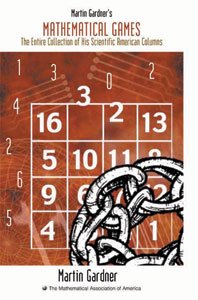 |
Martin Gardner's "Mathematical Games" Gardner's Scientific American column "Mathematical Games" on a single, searchable source |
 |
aha! Gotcha / aha! Insight 144 wonderful puzzles from the reigning king of recreational mathematics. |
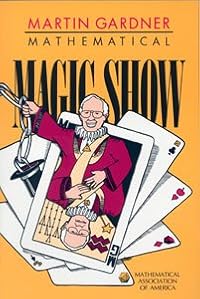 |
Mathematical Magic Show Nineteen tantalizing conundrums. |
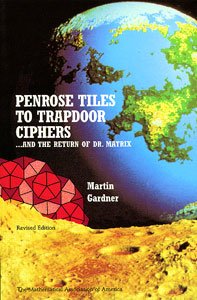 |
Penrose Tiles to Trapdoor Ciphers Included here are chapters on Conway's surreal numbers, Mandelbrot's fractals, and Smullyan's logic puzzles. |
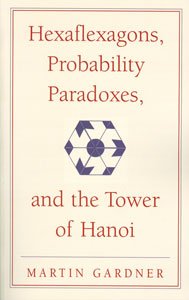 |
Hexaflexagons, Probability Paradoxes, and the Tower of Hanoi The inaugural volume in Martin Gardner's New Mathematical Library. These mathematical recreations delight and perplex while demonstrating principles of logic, probability, geometry, and other fields of mathematics. |
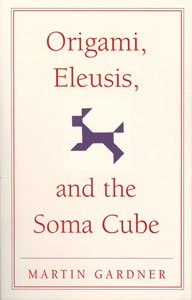 |
Origami, Eleusis, and the Soma Cube The second volume in Gardner's New Mathematical Library, updated chapters, including new game variations, mathematical proofs, and other developments and discoveries, to challenge and fascinate a new generation of readers. |
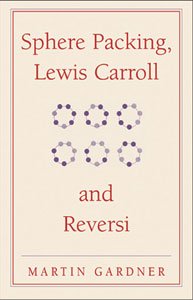 |
Sphere Packing, Lewis Carroll, and Reversi Packing spheres, Reversi, braids, polyominoes, board games, and the puzzles of Lewis Carroll. |
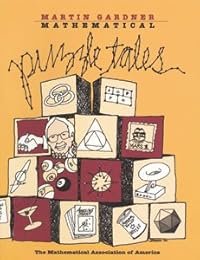 |
Mathematical Puzzle Tales The challenging problems presented here are based on geometry, logarithms, topology, probability, weird number sequences, logic and virtually every other aspect of mathematics as well as wordplay. |
Friday, October 12, 2012
New Book: Explorations in Complex Analysis

Available in the MAA Store and the MAA eBook Store.
Read the introduction of Explorations in Complex Analysis (pdf)
Explorations in Complex Analysis is written for mathematics students who have encountered basic complex analysis and want to explore more advanced projects and/or research topics. It could be used as
- a supplement for a standard undergraduate complex analysis course, allowing students in groups or as individuals to explore advanced topics,
- a project resource for a senior capstone course for mathematics majors,
- a guide for an advanced student or a small group of students to independently choose and explore an undergraduate research topic, or
- a portal for the mathematically curious, a hands-on introduction to the beauties of complex analysis.
Research topics in the book include complex dynamics, minimal surfaces, fluid flows, harmonic, conformal, and polygonal mappings, and discrete complex analysis via circle packing. The nature of this book is different from many mathematics texts: the focus is on student-driven and technology-enhanced investigation. Interlaced in the reading for each chapter are examples, exercises, explorations, and projects, nearly all linked explicitly with computer applets for visualization and hands-on manipulation.
There are 16 Java applets and a Java application, CirclePack, that allow students to explore the research topics without purchasing additional software. The electronic version of the book contains links to the applets and CirclePack. The print book (available soon in the MAA Store) contains information for downloading everything.
Friday, October 5, 2012
Dora Musielak on Wild About Math
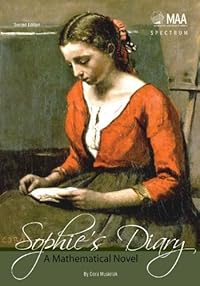
"Dora Musielak is literally a rocket scientist who wrote a historical novel, Sophie's Diary, with a good dose of mathematics in it," writes Lederman. "Sophie's Diary is the story of the coming of age of a teenager during the French Revolution. Dora and I discuss why she wrote the novel, about her earliest memories of loving math, how parents can inspire their kids to love math, and more."
Listen to the full interview.
Read an interview with Musielak from MAA Books blog.
Friday, September 28, 2012
2012 Fall Catalog on MAA Books

Browse our 2012 Fall Catalog for new and soon to be published titles, as well as many other MAA favorites.
Friday, September 21, 2012
NPR's Science Friday Discusses Flatland
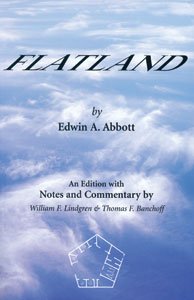
Flatland, Edwin Abbott Abbott's story of a two-dimensional universe, as told by one of its inhabitants who is introduced to the mysteries of three-dimensional space, has enjoyed an enduring popularity from the time of its publication in 1884. This fully annotated edition enables the modern-day reader to understand and appreciate the many "dimensions" of this classic satire. Mathematical notes and illustrations enhance the usefulness of Flatland as an elementary introduction to higher-dimensional geometry. Historical notes show connections to late-Victorian England and to classical Greece. Citations from Abbott's other writings as well as the works of Plato and Aristotle serve to interpret the text. Commentary on language and literary style includes numerous definitions of obscure words. An appendix gives a comprehensive account of the life and work of Flatland's remarkable author.
Get your copy of this classic in the MAA Bookstore!
Related:
Science Friday posted an excerpt of a review of the book originally published in The New York Times in 1885. Article.
Friday, September 14, 2012
New Book: Mathematics Galore!

Mathematics Galore! Showcases some of the best activities and student outcomes of the St. Mark’s Institute of Mathematics and invites you to engage the mathematics yourself! Revel in the delight of deep intellectual play and marvel at the heights to which young scholars can rise. See some great mathematics explained and proved via natural and accessible means.
Based on 26 essays (“newsletters”) and eight additional pieces, Mathematics Galore! offers a large sample of mathematical tidbits and treasures, each immediately enticing, and each a gateway to layers of surprising depth and conundrum. Pick and read essays in no particular order and enjoy the mathematical stories that unfold. Be inspired for your courses, your math clubs and your math circles, or simply enjoy for yourself the bounty of research questions and intriguing puzzlers that lie within.
Look for Mathematics Galore! in the MAA Store.
Friday, September 7, 2012
Michele Intermont Reviews Sophie's Diary
Michele Intermont, associate professor of mathematics at Kalamazoo College, reviewed Dora Musielak's Sophie's Diary: A Mathematical Novel.
Sophie's Diary tells the story of Sophie Germain, the first and only woman in history to make a substantial contribution to the proof of Fermat's Last Theorem. Germain grew up during the most turbulent years of the French Revolution. Her mathematical genius was discovered by Lagrange around 1797. Published research about Germain focuses on her achievements, noting that she assumed a man's name at the École Polytechnique in Paris, to submit her own work to Lagrange. Yet, no biography has explained how Germain learned mathematics before that time to become so sure of her analytical skills to carry out such a daring act. Sophie's Diary is an attempt to answer this question: How did Germain learn enough mathematics to enter the world of Lagrange's analysis in the first place?
"Reading a diary is such a verboten act! But reading Sophie's Diary should not be," wrote Intermont for MAA Reviews. "Dora Musielak has given us a delightful book of imaginings of mathematician Sophie Germain’s mind during the late 18th century. As we’re told in the author’s note, she was inspired to write this book because there is no record of how Germain managed to learn enough mathematics to make the substantial contribution to Fermat's Last Theorem that she did."
Intermont describes the ideal reader for this book as "a young girl looking to be enticed by mathematics (or whom one is looking to entice)."
"The book is written with many easy stopping points," she continues. "It’s a perfect format for introducing an idea or stating a question and letting the reader stop to ponder it for herself. But be advised: the author does intentionally include some inaccurate statements. This will keep readers on their toes, and either help the budding mathematician develop some skepticism or promote a bit of frustration."
Read the full review on MAA Reviews.
Get your copy of Sophie's Diary in the MAA Store.
BACK TO SCHOOL SALE IN THE MAA EBOOKS STORE!
Sale includes all textbooks and selected Classroom Resource Materials and Notes volumes. Full list here.
MAA Books blog special: Take an extra 5% off your MAA eBooks order using this coupon code: 892302153. Offer good until September 30. Happy reading!
Friday, August 17, 2012
Happy Birthday, Pierre de Fermat!
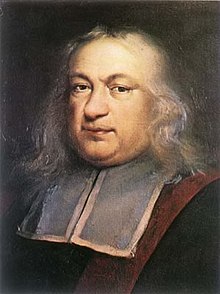
Pierre de Fermat (pictured), according to many sources, was born on this day in 1601 in Beaumont-de-Lomagne, France (link). But was this really his birthday?
Fermat was a lawyer and French government official who spent his spare time doing mathematics. He made important contributions to the foundations of differential calculus, but is most remembered for his work in number theory; in particular for Fermat's Last Theorem. "One day in 1637, while perusing his copy of an ancient Greek text by the 3rd century mathematician Diophantus, Fermat jotted a note in the margins that would drive mathematicians crazy for the next four centuries," wrote Eoin O'Carroll in an article for The Christian Science Monitor.
Fermat wrote: "It is impossible to separate a cube into two cubes, or a fourth power into two fourth powers, or in general, any power higher than the second, into two like powers. I have discovered a truly marvelous proof of this, which this margin is too narrow to contain."
Read O'Carroll's article to find out more about what The Guinness Book of World Records listed as the "World's Most Difficult Math Problem".
Want to read more about Pierre de Fermat? Try these books found in the MAA Bookstore.
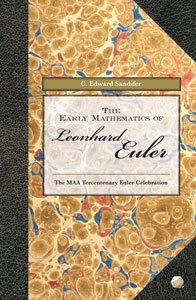
The Early Mathematics of Leonhard Euler
This series contains some of Euler's greatest mathematics including his first proof of the Euler-Fermat theorem.
Sophie's Diary: A Mathematical Novel
A novel about Sophie Germain, the first and only woman in history to make a substantial contribution to the proof of Fermat's Last Theorem.
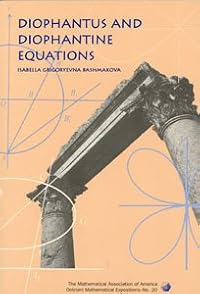
Diophantus and Diophantine Equations
This book includes substantial descriptions of the relevant contributions of Viéte, Fermat, Euler, Jacobi, and Poincaré.

Mathematical Cranks
Underwood Dudley's collection of humorous mathematical stories.
Friday, July 27, 2012
Mathematics and Sports

In celebration of the 2012 Summer Olympic Games, today's post will highlight the connection between mathematics and the games.
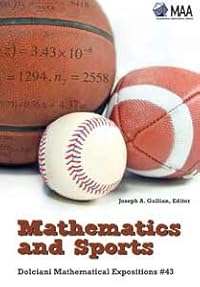 Edited by past MAA President Joseph Gallian, Mathematics and Sports is an eclectic compendium of the essays solicited for the 2010 Mathematics Awareness Month. In keeping with the goal of promoting mathematics awareness to a broad audience, all of the articles are accessible to college level mathematics students and many are accessible to the general public. The articles provide source material for classroom use and student projects. Many students will find mathematical ideas motivated by examples taken from sports more interesting than the examples selected from traditional sources.
Friday, July 20, 2012
Calculus Demonstration at MAA MathFest #MAAthFest

Where: MAA MathFest 2012 in Madison, Wisconsin
When: 2 PM, August 3 at the MAA Pavillion in the Exhibit Hall
Tired of your traditional Calculus textbook? Stop by the MAA Pavillion at 2 PM for a conversation and demonstration of Lang Moore and David A. Smith's Calculus: Modeling & Application, the MAA's interactive Calculus textbook.
Subscribe to:
Posts (Atom)